
As the core equipment in glass production, the operational stability of a glass furnace directly determines product quality, production efficiency, and overall cost. The transition zone—serving as the critical link between the melting zone and the downstream forming area—covers two key components: the Doghouse and the Throat. This zone plays a central role in controlling molten glass flow, maintaining thermal balance, and withstanding demanding operating conditions.
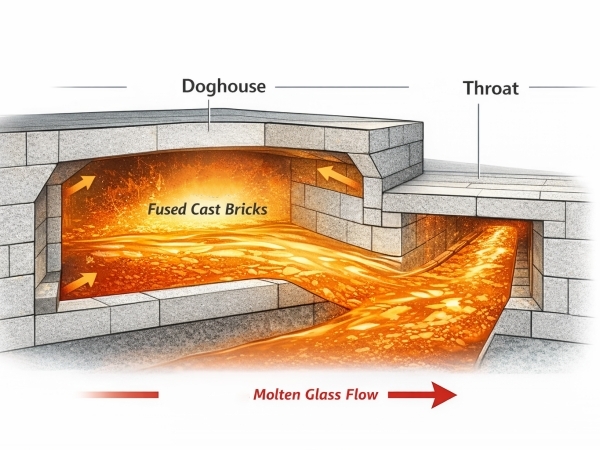
Due to its highly complex and variable service environment, the performance of refractory materials and the rationality of their design in the transition zone have a decisive impact on overall furnace campaign life and molten glass quality. Based on the specific operating characteristics of this zone, this article proposes targeted refractory material optimization strategies for the Doghouse and Throat areas, providing technical support for the efficient and stable operation of glass furnaces.
I. Importance of the Glass Furnace Transition Zone
The Doghouse and Throat together form the transition zone of a glass furnace. Each performs a distinct function while working in close coordination, acting as the critical "bottleneck" through which molten glass is transferred from the melting zone to the downstream forming area. The Doghouse is located at the end of the melting zone and upstream of the Throat, serving as a buffering and pre-conditioning area for molten glass. The Throat, positioned between the Doghouse and the downstream tank, is the key control point for accurately regulating glass flow rate and flow direction. The structural design and functional performance of these two components directly influence molten glass flow behavior, temperature uniformity, and the efficiency of impurity removal.
When molten glass enters the transition zone from the melting area, it typically exhibits characteristics such as non-uniform flow velocity, pronounced temperature gradients, and the presence of partially unmelted impurities. Under the high-temperature conditions of the melting zone, molten glass flows toward the transition zone under gravity. Due to differences in glass level and temperature between the melting zone and the downstream tank, turbulence, vortices, and localized stagnation zones are likely to form, resulting in non-uniform glass mixing. At the same time, unmelted particles, volatiles, and reaction by-products carried by the molten glass tend to accumulate in the transition zone, posing multiple operational challenges.
The transition zone is subjected to highly complex service conditions, mainly reflected in four aspects. First is high temperature and thermal gradient stress: temperatures in this area are typically maintained at 1400–1600 °C, and the combined effects of thermal radiation from the melting zone and heat dissipation from the downstream tank create significant temperature gradients, which can easily induce thermal stress cracking in refractory materials. Second is erosion and wear caused by molten glass flow: high-velocity glass flow continuously scours the refractory surface, with wear intensity significantly increasing in turbulent regions. Third is chemical corrosion: alkali metal oxides, fluorides, and other components in the molten glass can chemically react with refractory materials, forming low-melting phases that compromise structural integrity. Fourth is skull formation and blockage: impurities and volatile species in the glass may condense and deposit in relatively cooler areas, forming accretions that accumulate over time and can lead to flow channel blockage, reducing glass transport efficiency.
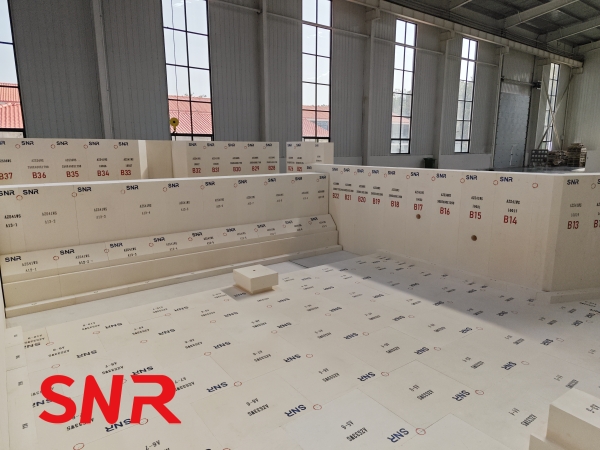
These challenging conditions directly result in rapid refractory wear and shortened service life in the transition zone. Frequent furnace shutdowns for maintenance not only increase operating costs but also disrupt production continuity and reduce product yield. Therefore, optimizing refractory material design based on the structural characteristics and operating demands of the Doghouse and Throat has become a key measure for enhancing glass furnace operational stability and reducing overall production costs.
II. Analysis of the Doghouse Area
1. Functional Role
The Doghouse serves as a buffering zone for molten glass before it flows from the melting area into the Throat. Its core functions can be summarized in three key aspects. First, it buffers and stabilizes glass flow velocity. Molten glass exiting the melting zone typically has a relatively high and unstable flow rate; by enlarging the flow cross-section, the Doghouse reduces glass velocity and mitigates the impact of turbulence on downstream areas. Second, it regulates the glass level height. By maintaining a stable level difference, the Doghouse provides the basis for precise control of glass flow through the Throat, while also minimizing turbulence caused by glass level fluctuations. Third, it preliminarily balances temperature gradients. Through sufficient mixing of molten glass within the Doghouse, local temperature differences are reduced, creating a relatively uniform thermal environment for subsequent forming processes and minimizing product defects caused by temperature non-uniformity.
.jpg)
.png)
2. Typical Issues
Due to its demanding service conditions, refractory materials in the Doghouse area are prone to multiple problems that restrict stable operation. First is thermal shock cracking. Frequent temperature fluctuations and pronounced thermal gradients induce uneven thermal expansion and contraction in refractories, generating thermal stress. Over time, this leads to cracking and spalling. Once cracked, the load-bearing capacity of the refractory decreases, and the exposed surfaces are rapidly attacked by molten glass. Second is molten glass corrosion. Because molten glass has a relatively long residence time in the Doghouse and is in prolonged contact with refractory surfaces, alkali metals, heavy metals, and other components can penetrate the refractory matrix, disrupting the crystal structure and causing strength degradation and surface spalling. Third is skull formation and material buildup. Unmelted particles and volatile species carried by the glass tend to condense and deposit on the glass surface and in the corner areas of the Doghouse, forming accretions. These deposits not only reduce the effective flow cross-section but also adhere strongly to refractory surfaces, leading to material loss during cleaning. Fourth is mechanical wear. Hard particles entrained in the flowing glass continuously abrade refractory surfaces, with particularly severe wear occurring in regions with glass level fluctuations and at high-velocity edges.
3. Application and Optimized Design of Fused Cast AZS Blocks
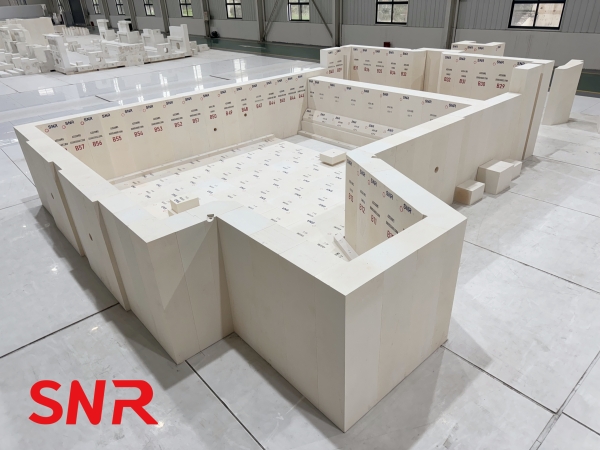
In response to the functional requirements and typical issues of the Doghouse area, high-performance fused cast AZS blocks are selected as the core lining material. Design optimization is carried out from three aspects: material selection, block layout, and process optimization, to enhance overall performance.
Material selection. Priority is given to high-density, low-porosity, and chemically resistant fused-cast zirconia–alumina blocks. Manufactured by the fused-casting process, these materials feature a dense internal structure with porosity typically controlled below 3%, effectively preventing the penetration of molten glass and corrosive media. In addition, their high ZrO₂ content provides excellent resistance to alkali corrosion and high temperatures, significantly enhancing resistance to chemical attack by molten glass. Compared with conventional fireclay or high-alumina bricks, service life can be extended by a factor of 2–3. To address skull formation, anti-adhesion coatings can be applied to the surface of fused-cast blocks to reduce the bonding strength between deposits and the refractory, thereby minimizing buildup.
.jpg)
Block layout and installation. A modular design concept is adopted. Based on the structural dimensions of the Doghouse, fused-cast blocks are cut into standardized modules. Staggered joint masonry is used between modules, with joints filled using high-temperature sealing compounds to ensure lining tightness and prevent molten glass penetration into joints. At the same time, block orientation is optimized according to the glass flow direction, allowing smooth transitions between refractory surfaces and glass flow, reducing flow resistance, turbulence impact, and localized wear.
Process optimization. On the one hand, the surfaces of fused cast AZS blocks are mechanically ground to achieve a smoother finish, improving surface flatness and reducing eddy formation and stagnation zones during glass flow, while also decreasing the tendency for deposit adhesion. On the other hand, localized cooling techniques are applied at key areas prone to severe wear and skull formation. Embedded cooling pipes are installed, and cooling intensity is precisely controlled to lower local temperatures, slow chemical corrosion and deposit formation, and alleviate thermal stresses caused by temperature gradients, thereby reducing the risk of cracking.
III. Analysis of the Throat Area
1. Functional Role
As the core control point of the transition zone, the Throat is structurally characterized by a narrow channel. Its primary functions are concentrated in two aspects. First, it precisely controls the flow direction and flow rate of molten glass. Through its restricted channel geometry, the Throat limits and regulates the volume of glass entering the downstream tank, ensuring stable and consistent flow and providing accurate control for forming operations. Second, it ensures a smooth transition of molten glass. By optimizing channel geometry, turbulence and vortices generated during glass flow are minimized, allowing molten glass to enter the downstream tank in a stable flow regime and preventing product defects caused by unstable flow conditions.
.jpg)
2. Common Issues
Due to its narrow channel and high glass flow velocity, the Throat operates under significantly harsher conditions than the Doghouse, and related issues are more pronounced. First is high-velocity glass erosion. Within the Throat channel, glass velocity increases markedly; combined with the restricted cross-section and high flow resistance, molten glass exerts intense scouring forces on refractory surfaces. This is especially severe at channel inlets, outlets, and corner areas, where rapid wear often leads to localized recessing and spalling. Second is high-temperature vapor corrosion. Water vapor and alkali metal vapors generated by molten glass volatilization at high temperatures can penetrate refractory materials and react with their constituents, forming volatile or low-melting phases that compromise structural integrity. Third is skull formation and blockage. Given the narrow geometry of the Throat, impurities and volatile species carried by molten glass tend to deposit on channel walls, forming accretions that gradually reduce the effective cross-section over time and may ultimately cause blockage, interrupting glass flow. Fourth is thermal stress concentration. Significant temperature differences exist between the two sides of the Throat channel, and frequent temperature fluctuations caused by high-velocity glass flow lead to localized thermal stress concentration. This often results in cracking and block detachment; once cracking occurs, erosion and corrosion are further intensified, and detached fragments may contaminate the molten glass.
3. Application and Optimized Design of Fused Cast AZS Blocks
In response to the severe operating conditions of the Throat area, fused cast AZS block application and design optimization are carried out with the core objectives of high wear resistance, corrosion resistance, thermal shock resistance, reduced flow resistance, and anti-skull formation, thereby enhancing operational stability.
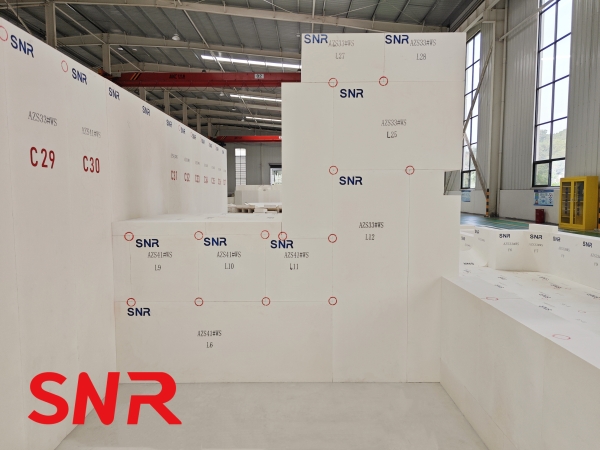
Material performance optimization. Dense fused-cast zirconia–alumina blocks with excellent chemical corrosion resistance, high wear resistance, and a low coefficient of thermal expansion are selected. Compared with the fused-cast materials used in the Doghouse area, these blocks are formulated with a higher ZrO₂ content—exceeding 90%—and an optimized grain structure, resulting in increased hardness and wear resistance capable of withstanding high-velocity glass scouring. The low thermal expansion coefficient reduces thermal stresses induced by temperature fluctuations, improving thermal shock resistance and lowering the risk of cracking. In addition, these materials exhibit outstanding resistance to high-temperature vapor attack, effectively preventing vapor penetration and degradation of the refractory matrix.
Block layout and structural design. The modular design concept is retained, while being adapted to the narrow-channel characteristics of the Throat through a streamlined arrangement. Refractory blocks are machined into curved profiles, forming smooth, streamlined inner wall surfaces that reduce eddy formation and flow resistance during glass movement, thereby lowering localized erosion intensity. Tongue-and-groove interlocking connections are used between modules to replace conventional masonry joints, enhancing joint strength and sealing performance, preventing molten glass penetration into joints, and improving the overall load-bearing capacity of the lining to avoid block displacement or detachment under high-velocity scouring.
Fluid dynamic optimization. Computational simulations of molten glass flow within the Throat channel are employed to optimize the surface inclination angles of refractory blocks, ensuring precise alignment with glass flow trajectories. This further reduces flow resistance and localized erosion. At the same time, the width and depth of the Throat channel are rationally adjusted according to production requirements, ensuring accurate flow control while avoiding excessively high velocities that would cause excessive wear, thereby achieving a balance between flow regulation precision and refractory durability.
IV. Integrated Optimization of the Doghouse–Throat Transition Zone
As the two core components of the transition zone, the operating conditions of the Doghouse and Throat are closely interconnected and mutually influential. Optimizing a single area alone is insufficient to maximize the overall performance of the transition zone. Therefore, an integrated optimization strategy is required, focusing on material coordination, molten glass flow management, thermal management, and maintenance accessibility, to achieve efficient and stable operation of the entire transition zone.
Material coordination. Coordinated use of high-performance fused cast AZS blocks is implemented across both areas. High-density fused cast zirconia–alumina blocks are applied in the Doghouse, while highly wear-resistant dense fused cast zirconia–alumina blocks are used in the Throat. These materials complement each other in composition and performance, ensuring excellent overall resistance to corrosion, wear, and thermal shock throughout the transition zone. At the same time, unified coefficients of thermal expansion and standardized installation practices are adopted to minimize stress concentration at interfaces caused by material differences, preventing joint opening and cracking and improving overall structural stability.
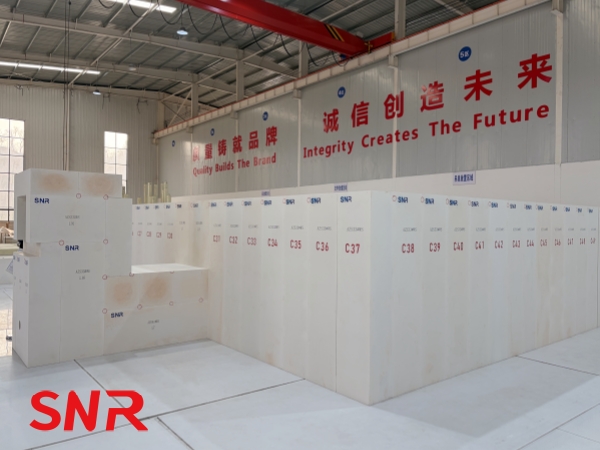
Molten glass flow management. Coordinated design between the Doghouse and Throat is strengthened to optimize glass flow behavior throughout the transition zone. By simulating molten glass flow across the entire transition zone, key parameters such as Doghouse volume and glass level, as well as Throat channel dimensions and inclination angles, are optimized. This allows molten glass to flow smoothly from the Doghouse into the Throat, reducing vortices and stagnation zones caused by abrupt velocity changes or flow deviation. In addition, flow-guiding structures are installed within the Doghouse to promote uniform glass flow, preventing excessive local velocities that could lead to wear and corrosion, and ensuring stable and homogeneous flow into downstream areas.
Thermal management. A combination of localized cooling and refractory structural optimization is adopted to balance temperature distribution and relieve thermal stress. Precisely controllable cooling systems are installed at locations prone to high thermal stress, such as Doghouse corners, Throat inlets, and outlets. By adjusting cooling water flow, local temperatures are regulated, and temperature gradients are reduced. Meanwhile, refractory thickness is optimized according to temperature distribution and mechanical load in different areas of the transition zone. Increased thickness in high-temperature regions enhances thermal insulation and load-bearing capacity, further reducing the risk of cracking induced by thermal stress.
Maintenance accessibility. Modular design is leveraged to improve maintenance efficiency and reduce operating costs. Standardized fused-cast modules are used in both the Doghouse and Throat, with simple and reliable connection methods. During maintenance, only severely worn local modules need to be replaced, eliminating the need for large-scale dismantling and significantly reducing maintenance workload and furnace downtime. In addition, inspection access points and observation ports are reserved at critical locations, enabling real-time monitoring of refractory wear and skull formation. This allows early detection and timely intervention, preventing minor issues from escalating into major failures.
V . Conclusion
In the Doghouse and Throat areas of the glass furnace transition zone, the use of high-performance fused cast AZS blocks has proven highly effective. Targeted material selection, block layout, and localized cooling strategies have addressed common issues such as thermal shock, erosion, chemical attack, and skull formation.
Optimized application of fused cast AZS blocks has resulted in:
►Significantly extended service life of refractory materials, reducing maintenance frequency;
►Improved glass flow stability and uniformity, minimizing turbulence and stagnation;
►Enhanced resistance to high-temperature corrosion and mechanical wear, particularly in critical high-stress areas.
These improvements demonstrate that careful selection and engineering of fused-cast refractories can directly enhance the operational reliability of the transition zone, providing a practical and measurable benefit in glass furnace performance.
For further technical discussion or application support related to fused cast AZS blocks in glass furnace transition zones, please contact:
 Email:moon@snrefractory.com
WhatsApp:+86 188 3808 9557
